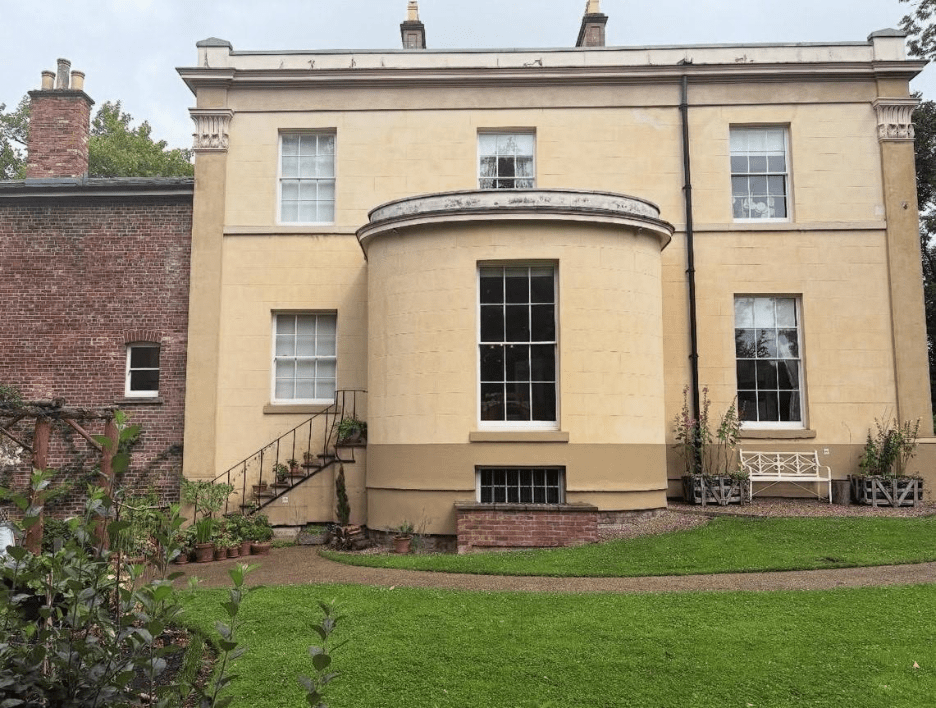
‘Tell Hearn all her wits are wanted in this desolate, butterless, headless, washerwomanless, company full household’ – Elizabeth Gaskell – 1860.
Gaskell
The above quote is one of the many fascinating things displayed on the walls of this magnificent home. As a literature fan, Elizabeth Gaskell’s House was an easy first pick for me to kick off the 111 places challenge. A few months prior to this endeavor, I had visited the Gaskell memorial in Knutsford. (Knutsford is also well worth a visit – voted one of the best places to live in the Sunday Times (Jordan, B. Undated) and does also appear in the challenge.
The Gaskell House is a small museum in Manchester. Situated on Plymouth Grove, which is not too far from the centre but nicely enough tucked away to evade the large crowds. (I discovered that this problem is harder to evade on some of the 111 places I have visited since, and I am sure it will be a persistent one).
The building is one that the Gaskells had lived in and gives us a convincing portrayal of what life would have looked like in Victorian Manchester for someone of their class. The book informs us that not many items in the house were owned by the Gaskells, but that the items chosen and the colour schemes used to decorate the house were carefully selected to depict this period as accurately as possible. (Treuherz, J and Figueiredo P. 2024). Regardless, this property was one that was lived in by a very important author with a more interesting background and family than I had realised. It is a delightful experience to step into this picturesque home and imagine what life would have been like for the Gaskells.
Before I visited the house, I had read both North and South and Cranford. I am particularly fond of Cranford, but both are excellent. (On Goodreads, I gave Cranford a five and North and South a four, if you were interested to know.) After visiting the museum, I purchased Mary Barton and read this the following week. (Goodreads, four, Cranford is still the top). Her novels famously include themes of class, industrialisation, and gender – you will also hear about this at the museum, either from the written displays dotted around or from the guides, should you wish to hear from them. (More on this subsequently). But industrialism and novels cited as “social problem” novels were rife in the 19th century. Whilst these themes are prevalent in Elizabeth’s novels, there has been speculation surrounding how much of it she would have witnessed or been involved in herself. (Barton, A, and D, Duffy, 2020). My visit to this one has prompted me to read the rest of Elizabeth’s works and to reread North and South. I was bit younger when I read it and read Cranford in more recent years. My increase in admiration and interest in Gaskell I think, will make me appreciate Gaskell more. That, and my increase in maturity and knowledge. (I hope.) I do think being interested in literature and Gaskell does help make this an enjoyable experience, but it would be very easy to enjoy this place without any knowledge of Gaskell at all. The house itself is a delight to walk around, and it is interesting from a historical perspective to see how different things were. There is a small but beautiful garden to peruse and a café/gift shop on the lower floor. Whilst I do believe that book lovers will be the biggest fans, Gaskell’s House offers enough intriguing history, aesthetically pleasing architecture, and an alluring garden to please the public. (I do think children would get bored, just send them to their grandparents.) Additionally, it’s not a big place, so it can be quite a short trip if you’re not like me and you don’t have to read everything and listen to all the guides.
I read some reviews of the museum after my visit (not before, which I understand is the norm, but I’m cool), and there was one thing that I thought might be a point of contention, and that is the enthusiastic guides. I will start by saying I was a fan, but I knew that it would be a bit much for some others. As I mentioned previously, it’s not a large museum and there was a guide situated in each room of the house as you went round, so it can seem overbearing if you want to have a more private walk around. To quote Gareth from a Google review, “They are very intense, and it is best to avoid engaging them in conversation or you might never get out.” I was pleased to see that most of the reviews were happy with the guides; however and it is worth noting that they do ask you if you would like them to tell you stuff or if you want them to leave you alone. I said I was happy with them to tell me stuff, and I was glad that I did. Even though I was a fan of Gaskell’s novels, I hadn’t delved much into her background or her family life, and it was great to learn more from people who were clearly passionate about the topics. My favourite was the very pleasant (slightly deaf – she informed me) lady in the study who told me lots of interesting stuff about Elizabeth’s husband, William, and utilitarianism. I knew next to nothing about some of this and began to feel like a Gaskell poser, but at least now I’m better equipped should a stranger in a pub quiz me on Gaskell. Sadly, this has yet to happen.
The Museum
I arrived before the museum was open (always keen). Arriving punctually at 10:45, fifteen minutes before doors open. This was a good decision, as I got to enjoy the garden by myself for a whole ten minutes before the next eager beavers arrived five minutes early. Perfect opportunity to snap some photos of the garden and the house for the obligatory Instagram post. Then I had a few moments to just stroll through the garden, admiring the pretty flowers and imagining I was a pretty belle in a Victorian novel… Just kidding..
The rain did pick up momentum, which did put a dampener on this perusal, so for the last few moments, I took shelter in the doorway outside the museum entrance. Alongside the two other guests who had by now appeared and spoiled my roleplay!
It was nice to watch the rain across the garden from the shelter. When I had finished in the museum, it was nice and bright again, so it was like enjoying the beautiful scenery across different seasons, each splendid in their own rights. This is Manchester, though, so temperamental weather isn’t anything peculiar.
I was trying to open the door at exactly 11:00 – the alleged opening times! It did not budge! Instant panic – is it not open today? But I paid 8 pounds!
They opened the door at approximately 11:01, completely disrespecting my punctuality!
When you go in, you enter the hall, and you can catch a glance of the study to your right and the morning room to your left. Straight down the hall is the dining room. The very amicable lady at the front desk told me and my new companions which way to go around the museum, and I purchased a guidebook of the house. Where possible, I intend to obtain some kind of memento from each of the 111 places. Sometimes this is not possible, as found out immediately in place number two. From Gaskell, I got this guidebook, which I convinced myself would be the sole item I would buy. However, as previously mentioned, I also purchased Mary Barton. That was it. Until I also got a bookmark and a postcard.
Room 1 – The Morning Room
The first room you go into is the morning room. A cosy little room which has some interesting displays. For example, a desk with some books encased behind glass, the main feature being a diary where you can read the two open pages. With a quill next to it – how fancy! I would recommend buying the guidebook; it tells you some interesting little facts. To be honest, it was the only reason I remembered it was called the morning room and not just the front room. I won’t reveal too much, not wanting to plagiarise, but an example from this room was called the morning room, as it faces south-east and may have been designed as a bright room to enjoy breakfast.
Room 2 – The Study
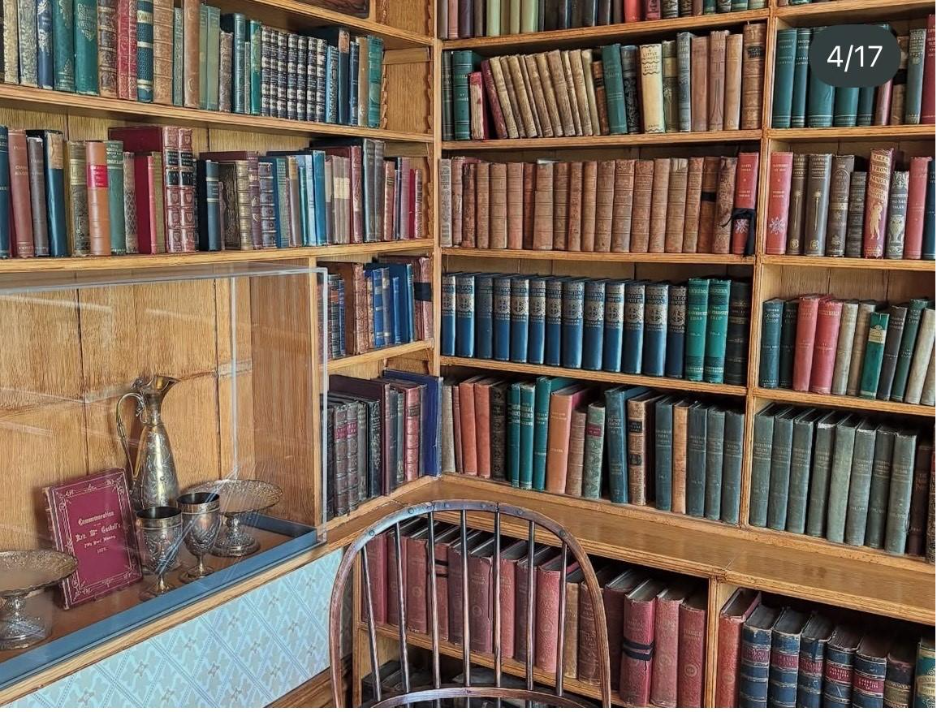
The second room you go into is the study, which I have said was a particular favourite. As well as liking the guide and finding the information she gave me particularly interesting, this room was a bit of me. It was full of books! Which you are allowed to take off the shelf and have a look through at your leisure. There is also a little box which you can open, and it starts recounting some tale for you. Unfortunately, I did get caught up on the conversation with the guide and did not really pay much attention to this. Maybe on a revisit. I would love a room like this in my house. One day.
Room 3 – The Drawing Room
Next, you go into the Drawing room. The guidebook states that this was the “main entertaining room” in the house. A quaint little room. Knowing Gaskell herself was so infatuated with having her study adds to the glee of walking around this room, but I would say this was the least magnificent of the rooms. Maybe I found less joy in this one because this was the only room where I didn’t interact with the guide. She was already mid-conversation with a couple who were either rushing through the house or had gone against the recommended way around because I was the first one in. (Naughty!)
Room 5 – The Dining Room
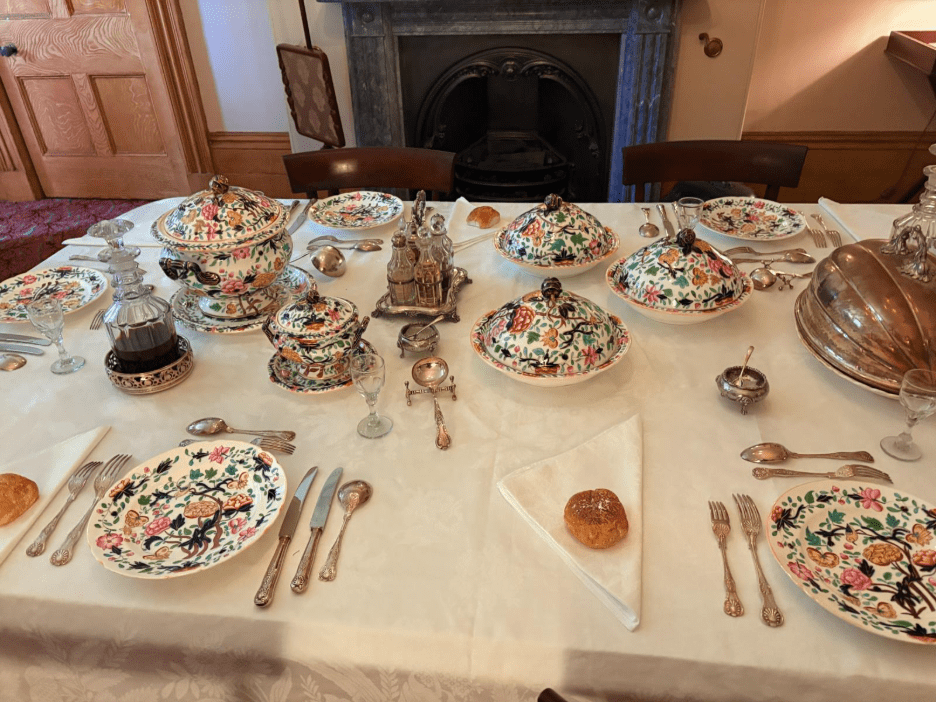
Moving on to the dining room. If you are like me, you will be imagining yourself in an old Victorian drama, sitting around the table discussing some scandalous affairs. This is a great room for some immersive imagination; you should have seen the scene I was involved in!…
The tour told me this was the room that they would have had the piano in. It is not a small room, but there is a lot already here, so it is difficult to picture a big piano in here too. Apparently, the table extended too. I guess when needs must! I would have just put up a TV myself.
The dining room is well placed and there is a big window with a spectacular view of the garden. We were informed that this is where Gaskell did a lot of her writing, and it is believable that she did it here. If I had brought my laptop with me, I would have whipped it out and written this by the window, too!
Room 6 – Hallway & The Guest Room (Bronte Room)
After the dining room, you are back in the hall, but now you will be at the foot of the staircase. You can admire the small portraits and the altarpiece more closely. There is a small table and chair at the top, which I found peculiar.
When you get upstairs, there is the “Bronte Room’ which was originally the guest room. The guidebook and information littered around the museum mention Gaskell and her friendship with Charlotte Brontë. Adds a greater appeal for literary fans, not a bold claim to say that the Brontës are more popular than Gaskell. Anne is my favourite, though. (Acton Bell, because I’m an intellectual). This room was interesting, but it felt less like stepping to a Victorian home and really let you know that this was a museum. Some very interesting bits to read, but not as visually stunning as the other rooms.
Room 7 – The Bedroom
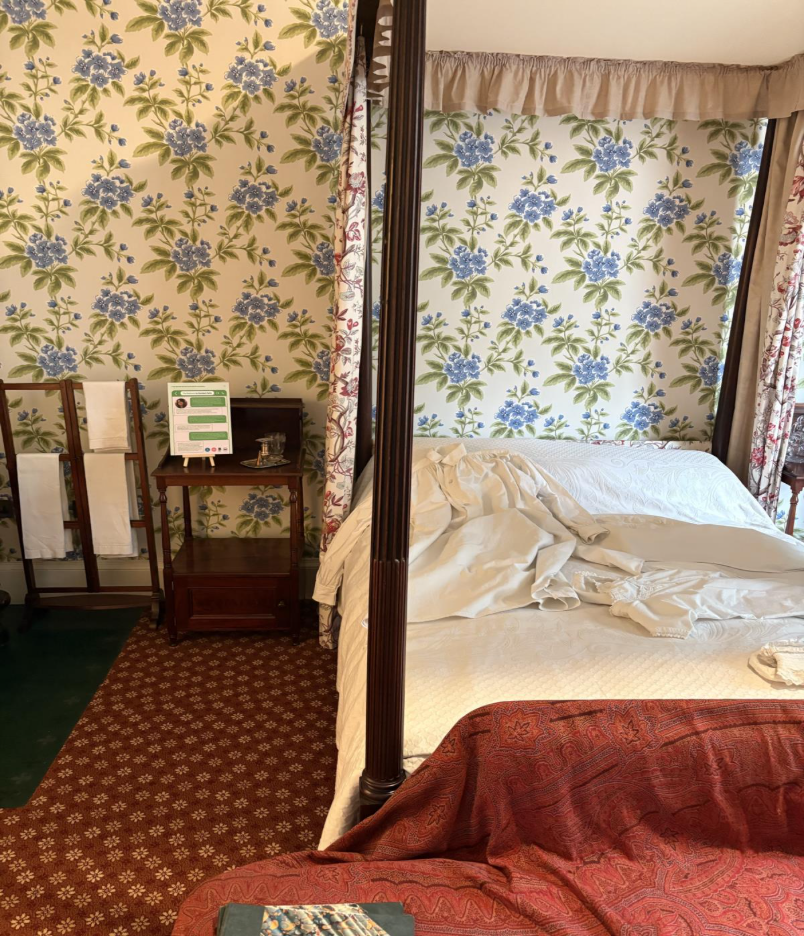
The bedroom was my next favourite room after the study. If there were just a full bookcase somewhere in the room, this could have been the winner. The tour guide told me a lot about this room and some background on how proud Elizabeth was of her bedroom and how important it was to her that it be nicely decorated. The story goes that Gaskell had gone to visit another lady’s home and was flabbergasted that her bedroom was so plain! In this room, you can also see some of Gaskell’s wedding attire, which is locked away so you can’t touch it, but magnificent to view. One of the smaller rooms in the house but has a more personal feel and interesting history. The tour guide was engaging and enthusiastic in this room too. I ended up staying in the room longer than I would have to listen because she was engaging.
End of the Tour & Overall Rating
After this, you can find some more bits of information displayed on the walls. (The quote at the top of this article is taken from these walls.) Then you go down to the basement. A little shop and a cafe. This is where I bought Mary Barton, and I also purchased a bookmark and a postcard. For each of these places I visit, where possible, I do try to get a little memento. Sometimes, it is not possible, so I make up for it by buying multiple at times like these.
I have decided to do a ranking system, and, full disclosure, I took this idea from the 1001 album club, which is a great podcast! For each one, I’ll do a rating of POSITIVE, NEUTRAL, or NEGATIVE.
Gaskell’s House was a great way to start off the challenge and a place I intend to revisit. My ticket lasts me the year, and they told me they do book sales on some Sundays. Lots of good information to absorb and some visually pleasing sights. Not a difficult one to rate.
RATING – POSITIVE.
See my Gaskell Instagram post @Dickinson95
References
- Barton, A and D, Duffy, (2020). Elizabeth Gaskell and the Industrial Poor. The Gaskell Journal. Vol 34. Available at: https://www.jstor.org/stable/48634415?read-now=1&seq=6#page_scan_tab_contents. Accessed 26/10/2025.
- Jordan, B, Undated). Sunday Times lists Knutsford as one of UK’s best places to live. Available at: https://www.knutsfordguardian.co.uk/news/25024043.sunday-times-lists-knutsford-one-uks-best-places-live/ Accessed 26/10/2025.
- Treuherz, J and Figueredo P. (2024) 111 Places in Manchester That You Shouldn’t Miss.” Edition 4,
 111 Places to Visit in Manchester Challenge
Leave a comment